

So I temporarily stalled out on weaving that gorgeous autumnal colors shawl because of a frustration on the selvages.
What’s a selvage? It’s the right and left edges of the woven fabric. This is where the weft thread comes over the warp edges and it’s supposed to be secure and tidy and perfect. I take pride in pretty selvages. But they are sometimes really hard to come by. You have to have all the working parts consistent.

When you place a weft thread over the warp threads, it’s not a straight line across. The weft needs to be angled so that it has the proper amount of take up. Too shallow and the thread pulls in the edge. Too high and it’s just sloppy. The fold of the weft over the outside warp thread need to be snug, but not tight. And it needs to be consistent.
I’m using a high quality tencel fiber that feels like silk. But some manufacturers and some colors tend to snap, especially at the edges. A fine mist of water on the warp usually helps while weaving, but sometimes even that doesn’t work. The most frequent culprit is draw-in. Draw-in is the difference between the width of the fabric before and after you place the weft threads.
Some amount of draw-in is nearly inevitable, but the wider the piece, the more likely you’ll see the draw in increase. And with fine threads, breaks are more likely. These can be fixed after the piece has been taken off the loom, but it slows down the process to have to replace the snapped fiber and slows down the finishing time making the mends.
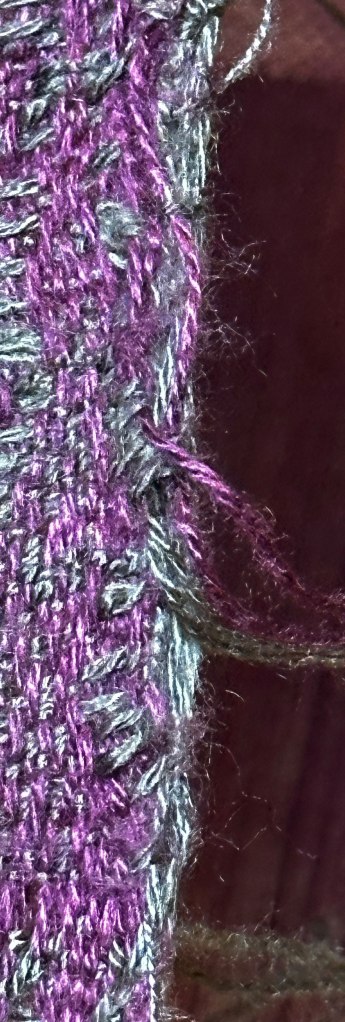
That’s just too much heartbreak. And it’s not the quality I want from my work. So I spent about 10 days researching options. I knew I had to fix the draw-in issue. The most common way to do that is with a temple. The most common temples are made of two interconnecting pieces of wood or plastic with teeth on the ends to dig into the fabric. The two piece of wood lock into place to spread out the fabric underneath.
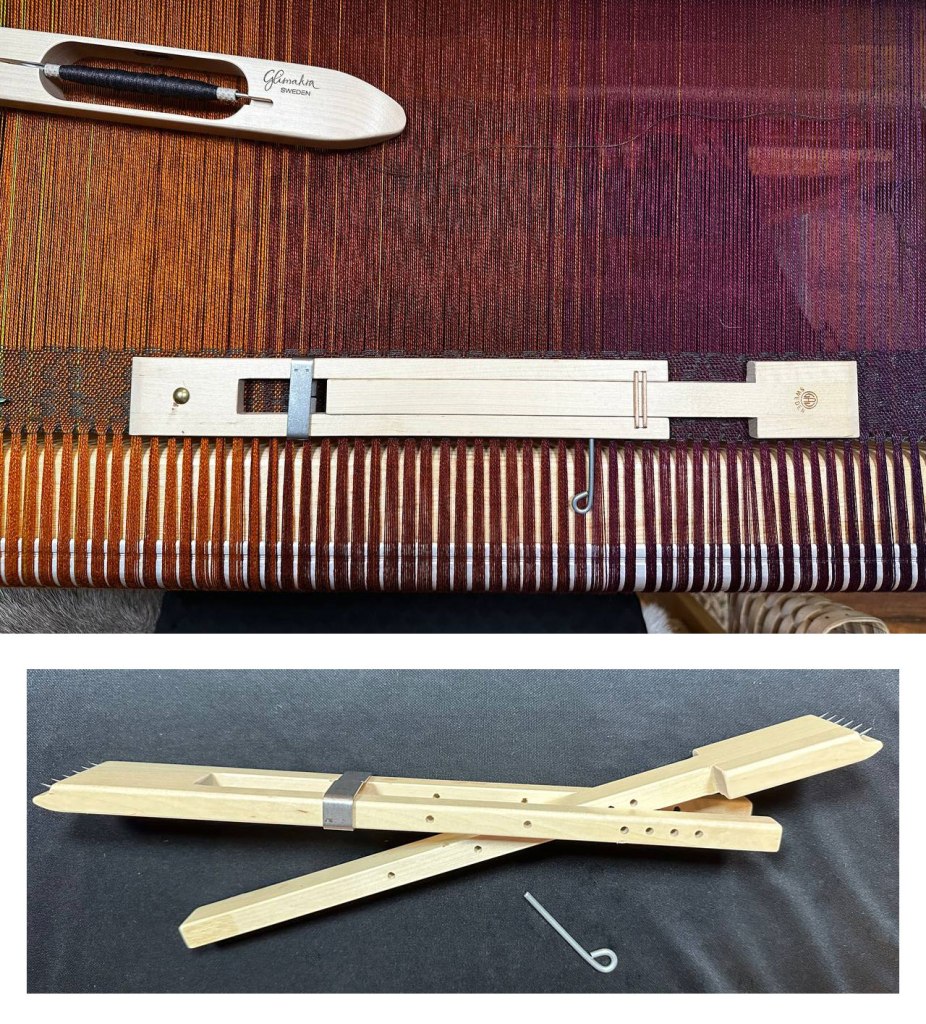
Temples are very limiting because each has a minimum and maximum length, with preset holes. And it has REALLY sharp teeth that I’m always concerned will harm the fabric. And my fingers. Yes, the top pic may have some blood stains on it. I think it helps the temple perform properly. So that’s two things that could harm the fabric. I kept digging for better answers.
I finally found what I think is going to be an amazing solution for two of my looms. It’s a clip and weight temple that’s really rather ingenious.

This system uses plastic clips. The bottom of the top part is serrated, but it’s dull so that it doesn’t pierce the fabric. Very nice to protect the edges. There’s a cord on the end that goes through two eyebolts I’ve put onto the loom. I know that some weavers would be horrified that I’m drilling holes into my beautiful Glimakra Standard loom and modifying it, but golly gee, I’m pretty sure the loom is thrilled to be of even more use. Tools are designed to allow you to modify them to make them into what you need them to be. Wee Glenna seems pleased that I’m back to weaving!

The kit I choose came with 3 different bar weights that clip on and off so you can use only the weight you need. The photo shows all three attached. Nothing is in the way, so it’s really a rather elegant solution
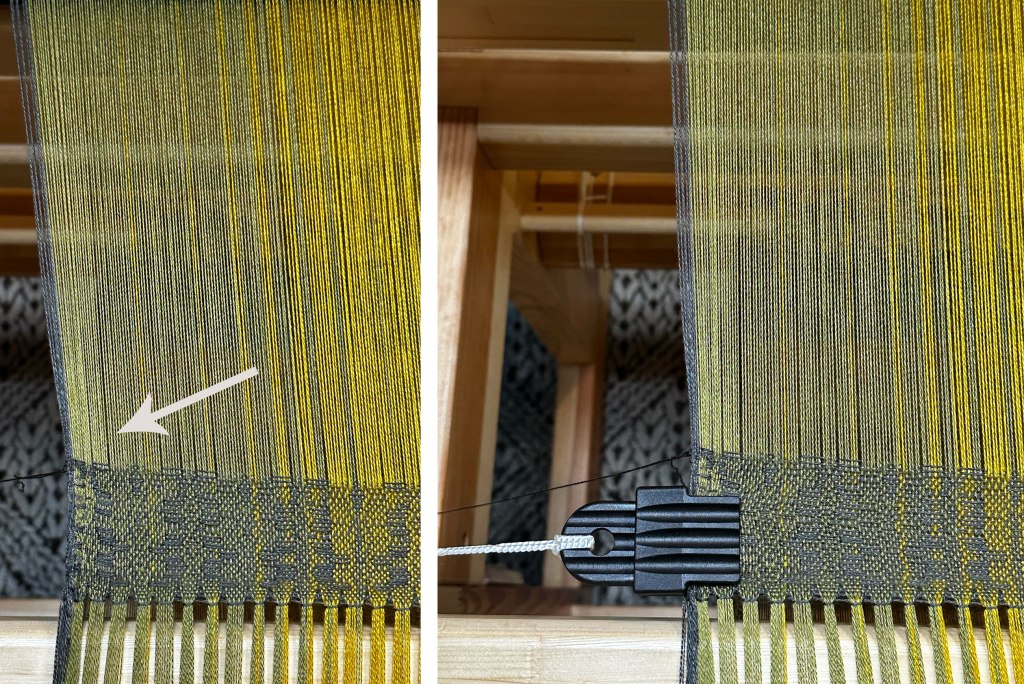
The arrow on the left photo shows how much the shawl had drawn in. There was a 1″ difference from the top width to the bottom and that’s a known issue. With the clip temple installed and weighted, the draw in is less an acceptable < 1/4″
I’m excited to be able to use this system on any piece I’m weaving now. I think it’s going to make weaving easier and more consistent. And all for a little under $100.
 Ravens Webs
Leave a comment