

Sometimes I like to design pieces with distinct stripes on the warp. That’s where one color stops and the next color begins. Easy to spot. For instance, the stripes on this dish towel I was weaving. The stripes on either side are solid, with purple stripes separating each color. The middle stripes are a little more complex because they alternate between a green and a turquoise thread, which blends the colors from a distance. These feel very deliberate, not organic.

Sometimes, I don’t want the colors to have such a definite stop and start. I want them to have a gentle flow from one to another. One of the ways this can be done so it’s very harmonious to the eyes is to use a pattern found in nature. I prefer to use the Fibonacci sequence. This is a mathematical progression that weavers discovered helps blend colors in a way that feels fluid and natural.
The Fibonacci sequence produces a subsequent number by adding the previous two numbers. I am using the sequence 1 1 2 3 5 8 13 21 34, then interlacing that sequence between two colors.
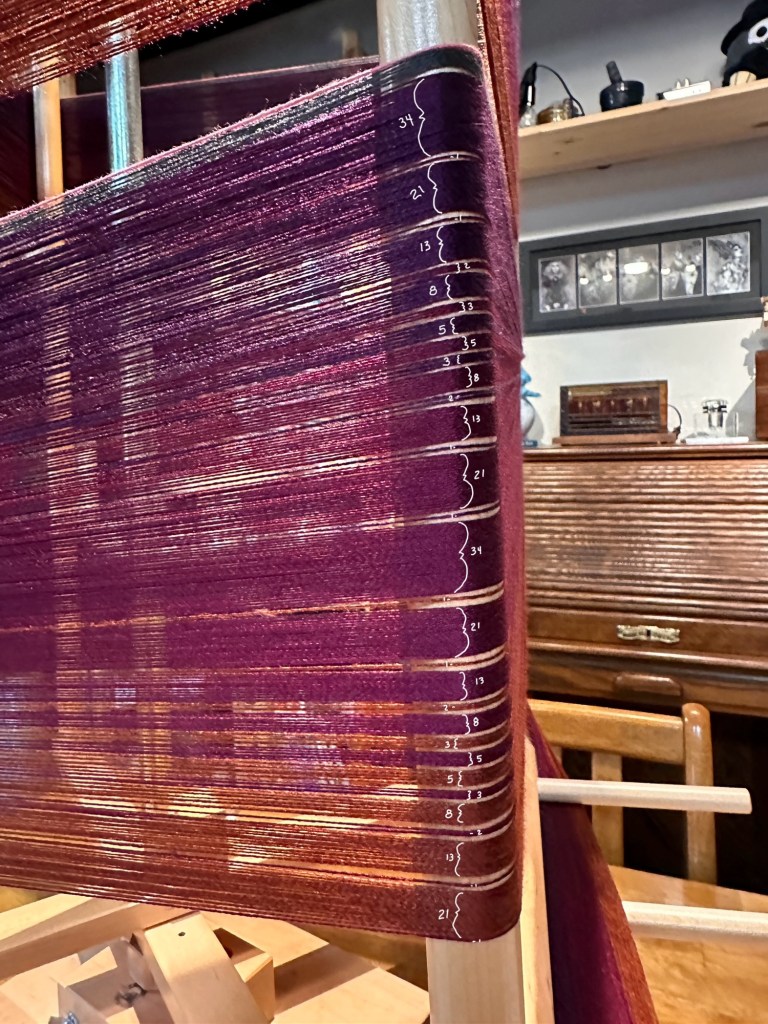
There are 3 colors blended in the image above. Eggplant to Fuscia to Spice. I started the sequence with the darker eggplant at 34 wraps around my warping loom. After the initial block of eggplant, I brought in the next color, fuscia, with a single strand. Then I alternated the two colors until I completed the sequence for the eggplant. I work down from 34 to 1 with eggplant. Fuscia gets worked up from 1 at the same time. Then I stopped using eggplant and brought in spice.
In the image there are 88 total strings of eggplant, 142 strings of fuscia, and 54 strings of spice. The fuscia completes the full progression from 1 to 34 and back to 1. This gives a gorgeous flow from one color to the next.

This is a little over 1/3 of this warp. I have 3 more colors to add. Striping this way takes a crazy amount of time to make sure you’re counting each color change correctly. It needs 752 strings, this is about 284.
At the top is a pink string, that’s my guide string since this is about a 6 yard warp. Then there’s 6 strands of a steel grey s as a border. That steel grey will be the weft color for pattern.
Winding a warp like this feels like I’m painting with fiber. It’s very soothing to watch the colors evolve!
 Ravens Webs
Leave a comment